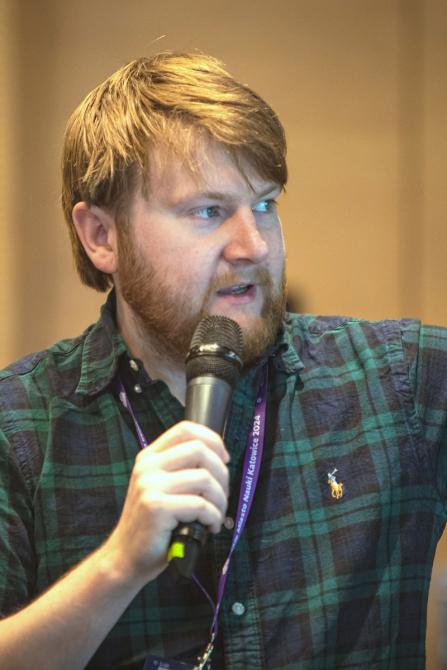
For years, he has successfully combined science communication with conducting research. He believes that scientists are responsible not only for what they do in the laboratory, but also for how they communicate their work to the public. Alex Baker, PhD, is an expert from the Department of Chemistry at the University of Warwick, who has received numerous awards for his scientific and science communication activities. His growing international reputation goes hand in hand with his involvement in the public sphere in the United Kingdom. He chairs the Baker Humanitarian Chemistry Group (BHCG), which seeks solutions to humanitarian healthcare problems, with a focus on the most marginalised communities around the world. He was also a guest at the 7th Silesian Science Festival Katowice and trained students, doctoral students and scientists in effective science communication as part of the School of Science Communication at the University of Silesia in 2024.
Weronika Cygan-Adamczyk: There is a lot of talk about science, with new websites and channels promoting scientific topics popping up all the time. And yet it seems that a large part of society still believes in conspiracy theories and has gaps in their basic knowledge, as evidenced by, among other things, regularly conducted Eurobarometer surveys. So does popularisation actually work? Or are festivals, the internet and television programmes just attractive spectacles and nothing more?
Alex Baker: I would argue it’s the reverse; we aren’t doing enough engagement with the public about science, rather than we are doing a lot and it isn’t working.
Take vaccine hesitancy; if, as scientists and medics, we had done a better job of engaging the public, especially the sceptics, then I think we would all have been better informed and more willing to engage with vaccine rollouts. As researchers, we should have seen that proving to the public the safety and efficacy of vaccines through engaging with public concerns as just as important as vaccine development. After all, if done badly, both lead to the same result—people not getting vaccines! This does mean we need to be prepared for robust open dialogue and to leave our ivory-tower university buildings.
I personally think one of the biggest issues is the lack of engagement many scientists have with mainstream news media (newspapers, TV news, etc). This leads to only the biggest stories reaching the national press and pushes a narrative of great scientific leaps and lone scientific genius rather than steady progress and teamwork.
Again, we saw this in COVID, where people talked about “changes” to the scientific guidance and scientists not “making up their minds”, when actually it was a steady building up of knowledge to give better guidance. But the narrative that often got pushed was “the scientists were wrong”, whereas the truth is that, as scientists, we are evidence-driven and when the evidence shifts, we shift too.
Weronika Cygan-Adamczyk: Some scientists I spoke to would be willing to share their knowledge, but they are often afraid of contact with the mainstream media, because someone might misrepresent what they say or take something out of context. I am sad to note that the media, especially the more mainstream media, lack a serious approach to science. For instance, I remember how a major TV station in Poland, while reporting on the Nobel Prizes, aired an anecdote that was not even related to the discipline in question, and did not even mention the names of the award winners! For many experts, this can be discouraging.
Alex Baker:I find this sentiment prevailing among my colleagues too; there is a fear that we might make a mistake live on air or be misquoted. But that is the risk we run when working with the media. Over time, though, you do build up a rapport with reporters, you understand their intentions and who you can trust. I would also say that if you are the world expert in the field, and you don’t do the press work, think about who they will find to replace you. For example, I have often found in the case of the global warming that when serious researchers don’t turn up for the press work, the press will (unintentionally) find less reputable sources and give them airtime. So, I think, as researchers, we need to accept the press isn’t perfect, but it is better to work with them and take the occasional mistake than let bad science fill the void left by not doing press work at all.
Weronika Cygan-Adamczyk: Practising science and popularising science are two separate fields that can consume a lot of time and energy, yet you effectively combine both of these spheres of activity. How do you divide your work between the two? Is it very challenging?
Alex Baker: For me, one flows into the other. We should do researcher-led public engagement, because as researchers, we are the authentic voice for our research. If we want the public to trust our research, we should be the ones advocating for it and facing public scrutiny. This does mean you need a thick skin as the public doesn’t mince their words, especially on social media! But I believe the public has a right to ask questions regarding my work—after all they do fund it. I also do my research for the benefit of humanity, so I don’t presume I know what is best for the public; I need their input.
It is tough dividing my time and getting the balance right though, so over the last few years I have followed two principles. One, equipping researchers and two, asking “where is the greatest value to the public?”. In the first case, I have realised I can’t be a one-man army, so training colleagues to engage with the public is important, as I can’t be everywhere and can’t be the authentic voice for everyone’s work. Second, I focus on reaching people who my colleagues can’t reach while aiming to maximise my impact.
Weronika Cygan-Adamczyk: What do you enjoy more: science communication activities or conducting research? Which of these activities is more demanding?
Alex Baker:They are both demanding for different reasons. The research is tough as it becomes a part of you, so when it is going badly you feel that personally. The engagement is tough because you can take flak from everywhere. I have had multiple comments made online about my appearance, voice and delivery, so it can be tough to want to keep doing it. That said, both are immensely enjoyable, at least most of the time, and it depends on the day to be honest!
Weronika Cygan-Adamczyk: Participants of the 7th Silesian Science Festival Katowice had the opportunity to learn about your science communication activities. As part of that, you mentioned the challenges that tropical diseases pose to global health. You also deal with this issue as part of the Baker Humanitarian Chemistry Group (BHCG) you lead. The research group website states that you are 'primarily interested in small molecule, peptide, polymer and carbohydrate solutions to understand and treat neglected tropical diseases'. What diseases are these and why are they neglected?
Alex Baker: As a group we are primarily interest in snakebite. I first came across this problem when I worked in Nepal as an aid worker and teacher. There I saw the impact snakebite can have on marginalised communities. It is a neglected tropical disease for which over 270 million people, with the lowest access to healthcare globally, have no cure. This is because the usual therapy of antibody-based treatments, while immensely profitable for cancer and covid, are simply too expensive for neglected tropical diseases such as snakebite.
These diseases, snakebite being one of them, are neglected as they receive the least funding and attention. They also impact some of the most marginalised and low-income populations around the world. But this doesn’t mean they don’t matter or have no impact. Statistically, every 5 minutes, 50 people are bitten by snakes worldwide, 4 will be permanently disabled and one will die. It is this unmet humanitarian need that drives my group and me in the research we do.
Weronika Cygan-Adamczyk: Your research group website states that the aim of the research is to focus “on creating and developing chemical solutions to humanitarian challenges impacting marginalised groups”. What role can chemistry play in this process? Could you give some examples of specific solutions?
Alex Baker: Often these medical problems have been the preserve of medics and biologists, but I believe there is value in wider interdisciplinarity, hence bringing Chemistry to the party. This is because chemistry and chemists bring different skills and solutions to the problem versus my more biologically minded colleagues. I believe these skills and solutions will be of value and we are seeing that in our early research using sugars to detect snake venoms in rapid, low-cost diagnostics. I can’t say more at the moment, as we are still doing the research.
Weronika Cygan-Adamczyk: People from marginalised groups have difficulty accessing medical services and medicines—even if a solution to their condition exists, they often cannot afford it. One of the goals stated on the BHCG website is to 'develop diagnostic platforms stable in a wide range of conditions, for a wide range of applications, for under $1 USD'. Is it really possible to find such a solution?
Alex Baker: I think it is. Our aim is to remove antibodies from medical devices and drugs, and replace them with synthetic solutions. These antibodies, while the mainstay of current treatments, are expensive, not very robust and hard to manufacture. We can make chemical solutions that overcome all these problems, hopefully for under $1 USD. For me, this also raises a big question about why we do science. Over the next few years, antibodies will dominate the healthcare market; they are already some of the most profitable medicines. But they are inaccessible to many. I do worry that our science may outstrip our humanity if we aren’t careful.
Weronika Cygan-Adamczyk: In addition to the interdisciplinary nature of your research, you also gather researchers from different cultures and backgrounds. How do you perceive the differences between how science is practiced in the UK and the methods used by scientists from other countries and continents?
Alex Baker: I think there is great value in diversity. Everyone comes with their own perspectives and experiences, and these can be incredibly useful in looking at problems from different angles. While as scientists we all believe in an evidence-based approach, the way we chose to collect that evidence and interrogate that evidence is different. We also have different priorities too. For example, I was in Denmark recently with a collaborator and they are very focused on biotechnology with societal impact in a way that we are not in the UK. Visiting them was incredibly useful as it helped me better define how my group can deliver real societal change.
Weronika Cygan-Adamczyk: In your scientific and science popularisation activities, could you point to something you are particularly proud of or, conversely, something that made you realise that a certain path or method is not necessarily the right one?
Alex Baker: I am particularly proud of two things on the science engagement side. First, giving talks at the Royal Institution of Great Britain where you get to lecture from behind the same desk as many world-changing scientists. Second, when I was in my twenties, I founded a science conference for students who often don’t get the chance to hear about science at university. Through that conference, which has now run for over a decade, multiple students have been inspired to study science university.
On the science side, when I was a PhD student, I was one of the first scientists to demonstrate how the COVID-19 virus binds to sugars. That was a proper “eureka moment”, it was something my boss, colleague and I had postulated, but to be the first people in the world to prove it was pretty cool.
When I was deciding what to do at university as an 18-year-old, I had the option to study medicine but realised that it wasn’t really for me. I wasn’t enough of a people person, and I felt I could have a greater impact through one good medicine or diagnostic, versus one patient at a time. So I studied chemistry instead, and I suppose the rest is history.
Weronika Cygan-Adamczyk: Thank you for the interview.
Interview by Weronika Cygan-Adamczyk
Photos by Agnieszka Szymala, Szymon Nawrat