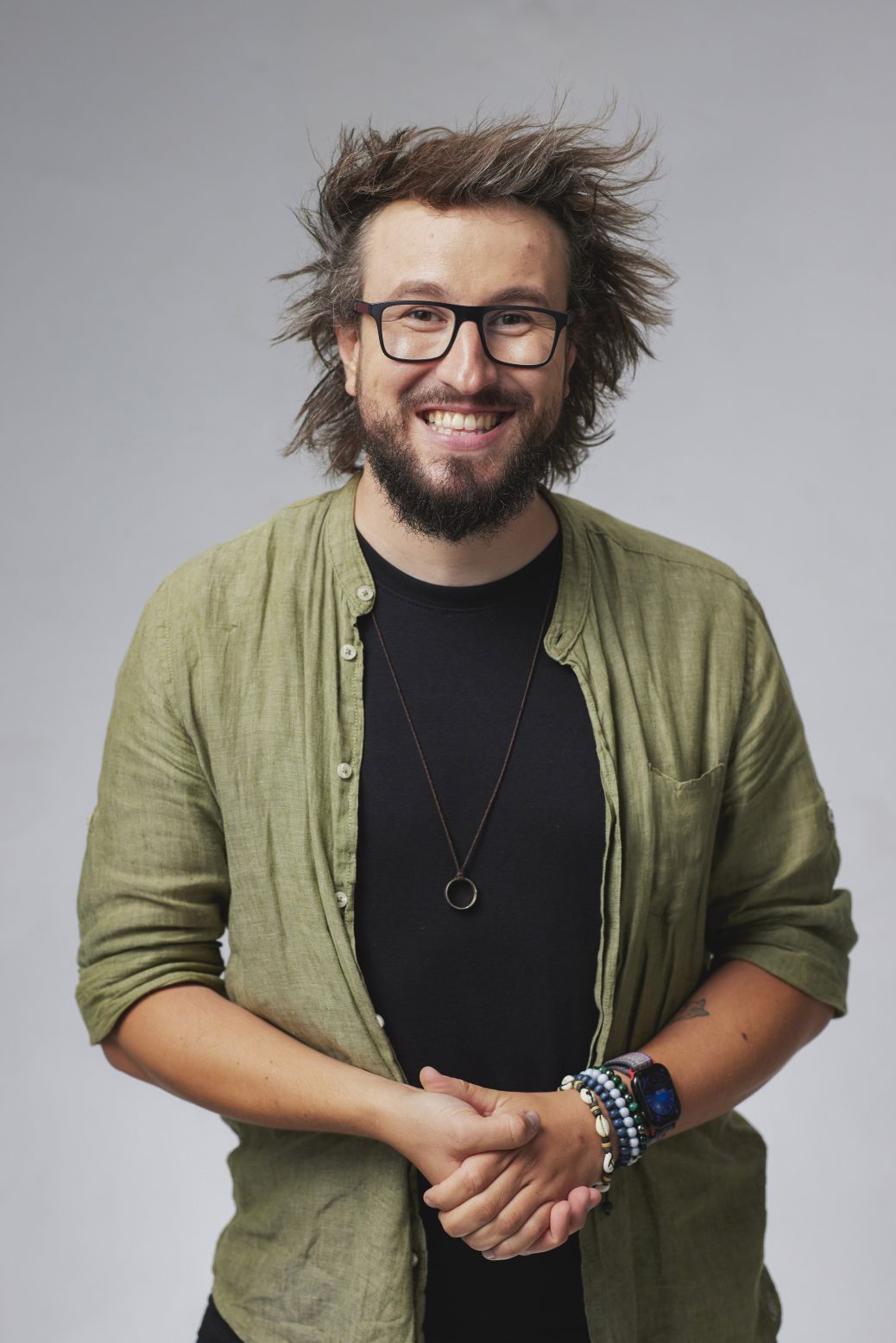
Karol Wójcicki — a photographer passionate about northern lights, a science communicator in astronomy, a scientific journalist, and a traveller. He shares his love for astronomy to thousands of people in Poland and around the world, and shows that sometimes to experience space in all its glory you just need to lift your head and take a look at the night sky above. He inspires people and shares his knowledge and passion. He is the creator of the largest astronomy fanpage in Poland ‘Z głową w gwiazdach’. Frequently travels thousands of kilometres to see a total solar eclipse. He is particularly fond of northern lights. He is the recipient of the Science Populariser Award presented by the Ministry of Science and Higher Education and the Polish Press Agency, the POP Science Award presented by the Silesian Science Festival in Katowice (of which he has been a guest on several occasions), and the ‘Golden Logo Poland’ badge awarded by the Polish Tourist Organisation.
Agnieszka Sikora: How did your science communication journey begin? Was it a consequence of some breakthrough moment, a specific event, a quick spark of inspiration, or rather a slow process of maturing passion.
Karol Wójcicki: Well, that’s an interesting question, because people usually ask me when I first became interested in astronomy, but here I’m being asked when I first became interested in promoting it (laughs). What makes it even funnier is that the answers are actually very similar, because it was almost a parallel process. It became clear very early on that I find it hard to keep my mouth shut when I see various phenomena in the sky and experience just how extraordinary they are. As far back as I can remember, I always was very eager to share my thoughts with others. It was a lot of fun to be able to tell somebody all about it – first, my parents and then also my friends, and even a school teacher. There were also some funny moments when, while standing at a bus stop and seeing a space station flying somewhere over Poland in the early evening, I would tell random people waiting at the stop about it. I still do that today, actually, because I reckon that’s part of my role – to draw attention to all the amazing things happening right above our heads. When I was 12 or 13, and my ordinary childhood fascination with space was increasingly turning into the observation of specific astronomical phenomena, my adventure with promoting astronomy also began.
Agnieszka Sikora: Based on your own school experiences, how do you feel about space education in Polish schools? Don’t you get the impression that schools – or rather the education system – assume that space isn’t interesting?
Karol Wójcicki: I try to rationalise it somehow. Of course, you could say that children are learning about the natural world, and it’s probably much easier for teachers to go to a park, a forest, a zoo or somewhere else during the day – places where they can interact with nature in a tangible way – rather than travelling out of town at night. Unfortunately, we currently live in an age where it is difficult to see the stars in the night sky. It’s a shame, but today a starry sky is something of a luxury. Most people in Europe are unable to see the Milky Way. The ubiquitous lights have robbed us of the view of the night sky, perhaps causing it to slip a little off our radar. The sky above a large city consists of just a few bright dots against a background that is more dark orange than black – and that doesn’t really appeal to anyone. On the other hand, space has ceased to be something marvellous and has become somewhat commonplace. Space technology has become part of everyday life; we don’t even notice the things we use every day, even though their origins lie in past space missions. Perhaps that is why we do not devote sufficient attention to this particular field of science. And so I ask myself: is there really a need today to educate anyone about astronomy?
I feel that we should set aside discussions about whether to promote or teach astronomy in schools, and instead start considering whether we ought to talk more about space and satellite technologies. This is something that will have a far greater impact on our daily lives and our future. So perhaps it would be better to show how these technologies work, how we use them and what benefits they bring us.
Agnieszka Sikora: It’s somewhat ironic that at a time when we already have such advanced technologies at our disposal and are travelling into space, misinformation and pseudoscience are still – or perhaps especially now – running rampant. Doesn’t it grind your gears when, yet again, you hear or read about flat-earthers, the denial of the Moon landing and other conspiracy theories? Because how are we supposed to explain this nonsense to people yet again? I should add: to people who do not accept a logical, scientific explanation.
Karol Wójcicki: It is ironic. A good fifty-odd years ago, nobody denied the Moon landing; what’s more, back then, for technical and technological reasons, it was easier to deny this fact and claim it was a hoax. There were also parties who had the greatest interest in ensuring the Americans failed to land on the Moon – the Russians, for one, and later the Chinese. And yet those countries never denied it. To be honest, I’m not quite sure what to make of this problem. There was a time when, like many other science communicators, I tried to explain, persuade, debate, and provide scientific evidence, research or observations confirming that people do fly into space, that the Earth is not flat, and that a man did land on the Moon. Now, however, I’m beginning to think that it’s probably pointless. All of us science communicators have a finite amount of energy, and we should use it for more important matters. I’m starting to feel that it’s better to channel this energy into educating young people and sharing science, rather than necessarily trying to convince someone that white is white when they refuse to believe it – with the emphasis on the word ‘believe’. Unfortunately, these discussions often have nothing to do with a substantive, scientific debate, the exchange of arguments and so on. It is often simply a discussion on a level that is almost religious in nature, concerning certain dogmas that someone has taken for granted somewhere along the line and will defend as if they were a matter of national independence. This is indeed difficult, because you cannot really fight against it. It’s a bit like trying to convert someone to a different religion. You have to do your bit as best you can, and hope that this work will be enough to make the world a better place in the future.
Agnieszka Sikora: Perhaps at some point these people lacked good educators or teachers? If we don’t have a subject like astronomy in schools (in secondary school rather than primary school, of course), how can we encourage young people to study not just astronomy, but the fields you mentioned earlier that are related to space technology or the space industry? The Copernicus Science Centre or science festivals are not enough on their own…
Karol Wójcicki: They’re not enough, of course, but they’re hugely important for society as a whole. They play a colossal role amongst those who are genuinely interested in science. On top of that, the role of science communicators is extremely important, because they’re the ones doing the work that teachers aren’t doing. Kids often ask themselves: What’s the point of these things like sine and cosine? Will I ever actually use this in real life? Will the knowledge of how to calculate the area of a triangle ever be of any use to me? And during such events as science festivals, they get something that isn’t available in schools: a narrative. And it is precisely this narrative that shows them how the knowledge they’ve acquired translates into the modern world. Young children have the advantage that they don’t need to be convinced that the Earth isn’t flat, because they take this knowledge and accept it without question. Once this knowledge is firmly established in their minds, perhaps they’ll be more resistant to the nonsense spewed out by the internet. The problem is that the content they come across online feeds heavily on dopamine rushes – it presents a certain vision of the world that isn’t simple, yet serves up convenient and easy explanations. But science does not always provide easy answers, which is why it often loses out to pseudoscience and conspiracy theories. It is easier to ‘get baited’ by them and feel good about suddenly having ‘got it’. That is why educating children from a very young age is of paramount importance. Not about the fact that the Earth isn’t flat or that the moon landing actually happened, but about how to verify information, how to understand what is true and what isn’t, when someone is trying to deceive you and when someone is genuinely educating you. These are the skills and competences that are sorely lacking in our society today.
Unfortunately, Polish schools – and the education system as a whole – continue to be based on a model rooted in a tradition dating back several hundred years, when an expert would stand before a group of pupils or students and tell them how things were – and what they said was not open to discussion. Such an all-knowing lecturer presents us with certain ‘revealed truths’, and pupils must accept and memorise them. There is no room for discussion. This pattern is exploited today by those who wish to spread misinformation. They take to the public forum – in this case, a YouTube or TikTok channel – and proclaim what is ‘the way it is’. And we’ve been taught that if someone tells us how things are straight up, then that’s probably true. We must, therefore, learn that someone might want to deceive us for various reasons: either deliberately or unwittingly, because they themselves lack sufficient knowledge. That is why the ability to verify information is one of the most important skills of the 21st century.
Agnieszka Sikora: Acquiring this skill isn’t easy, and on top of that there’s the challenge of dealing with the ‘creations’ produced by artificial intelligence – and that’s just the beginning…
Karol Wójcicki: That’s true; until recently, I prided myself on being able to recognise, without too much difficulty, what is and what isn’t the product of artificial intelligence. Today, I am horrified to discover that even I am finding this increasingly difficult. This shows that the task facing young people is not a simple one and requires truly robust skills, which need to be developed and incorporated into the education system. I cannot offer a simple formula for how to do this. Fortunately, there are experts who are already developing programmes of this kind, and we must listen carefully to what they have to say.
Agnieszka Sikora: Let’s go back to promoting astronomy. There are various ways of reaching the public. Of course, you can grab a microphone or a camera and talk about various events happening in the sky, but you’ve chosen the path of ‘hunting’ for astronomical phenomena, such as solar eclipses or the aurora. How did you come to choose this path?
Karol Wójcicki: These ‘hunts’ are my passion, but I also encourage other people to join me on this journey of personal adventures with astronomy. I realised a long time ago that in the modern world – although I do regret this somewhat, we have to go with the flow – emotions are very important. It is these emotions that draw people to all sorts of topics. That’s why, in my day-to-day work, I try to show just how much excitement astronomy gives me, how much fun I have with it, the extraordinary things I see, the phenomena I observe, and the adventures I have. I show people how I enjoy astronomy. Surely it could be done much better from an academic point of view, and sometimes communicated more accurately, but I’m on the front line, tasked with making people take notice of science, with fascinating them, so that later they’ll seek answers for themselves in lecture halls, at science festivals, or while reading insightful books.
Agnieszka Sikora: And what are your plans for the near future?
Karol Wójcicki: The total solar eclipse, of course, which will be visible in Europe on 12 August 2026. I’ve been chasing eclipses since 2008; over the last few years, I’ve travelled to various corners of the world to observe this phenomenon. For various technical and organisational reasons, I haven’t always been able to share this event with people quite as I’d like to, i.e. live, so that they could experience it with me somewhere on the other side of the world, far from civilisation, as was the case during the last few eclipses. This year, it will be much simpler. The eclipse will be visible in Spain and I’m already preparing for it. We’re taking a lot of equipment with us and we have stable satellite connections to ensure an independent internet source. Thanks to this, I’ll be able to share my impressions from the front line.
Agnieszka Sikora: I wish you good weather, then, and thank you very much for your time.
Interviewer: Agnieszka Sikora
Photos: private archives, Karol Wójcicki